
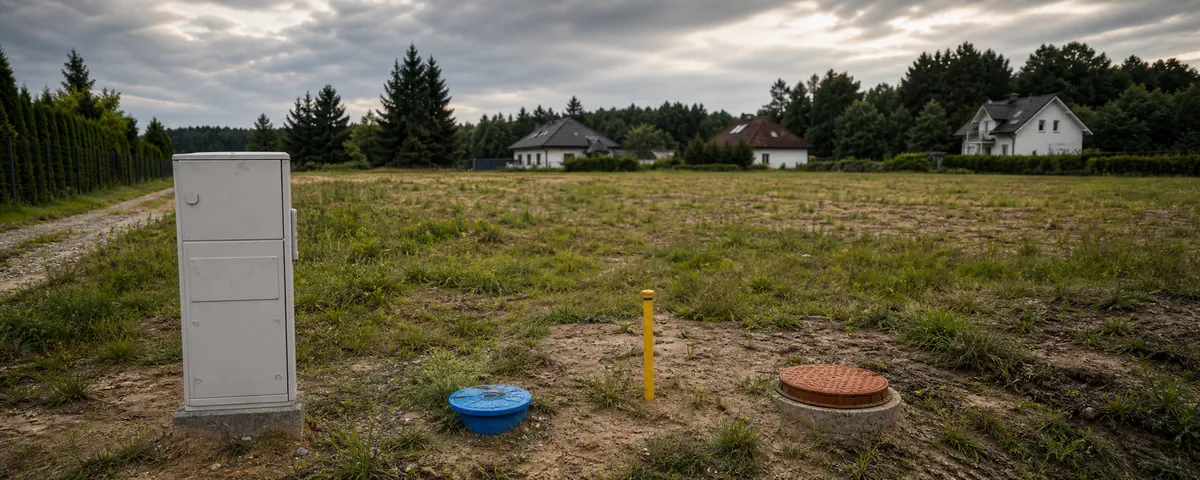
First obtain confirmation that your parcel can be connected. A mapped pipe or cable is not enough. Leave a field empty if you have no quote; enter zero only when no charge is confirmed.
Four different things a utility document can tell you
Scroll horizontally to read every column.
| Information | What it establishes | What remains open |
|---|---|---|
| A nearby network | An approximate mapped route of an existing or proposed network | Capacity, condition, permission, connection point and price |
| Connection conditions | The operator’s technical requirements for the stated proposal | The full investor’s budget where works are not priced |
| Connection agreement | The parties’ scope, charge and timing within that agreement | Excluded works, including installations beyond the ownership boundary |
| Complete budget | Comparable, priced scopes from the operator, designer and contractors | Items described only as “if necessary” or “by the investor” |
The GESUT layer in the state Geoportal covers existing and proposed networks using data supplied by counties. Save the map date, scale, parcel identifier and layer name, then identify the actual operator. A line on that map is not a connection offer.
Give every supplier the same project description
Prepare the parcel number and cadastral precinct, intended use, proposed building position, expected water and wastewater demand, electrical capacity, gas demand if relevant, preferred cabinet or chamber location and required completion date. Attach one sketch showing the parcel, road and building. Ask the designer to help specify demand rather than copying a neighbour’s installation.
For electricity and gas, ask the responsible operator about the technical and economic conditions. Read both the conditions and agreement to identify the boundary between the operator’s network and your installation. The energy regulator explains why that boundary determines responsibility; proximity alone does not settle it.
For water and sewage, follow the local undertaking’s current procedure. The water-supply legislation provides a 21-day period for single-family residential buildings, subject to its extension rules, and two-year validity for conditions. Issuing conditions and the statutory acceptance/connection activities must be distinguished from paying for design, materials and construction. MPWiK Warsaw is one documented example; it is not the operator for every municipality.
For broadband, check the declared address-level coverage at internet.gov.pl and then obtain confirmation for the proposed building. On undeveloped land, a nearby address can help locate a provider, but an offer for a neighbour is not an offer for your parcel.
A budget worksheet to copy for each utility
Calculate one connection, in PLN
Enter gross amounts in PLN from your documents and quotes. Count each cost once. An empty field means an unknown cost. Enter 0 only when free of charge is confirmed, or select “Not applicable”. Repeat separately for each utility. Your entries stay on this page and disappear when you reload it.
Enter amounts to calculate a total.
Use a separate copy for electricity, water, sewage, gas and broadband. Compare gross amounts when budgeting as a consumer, or record net amounts and VAT consistently in separate fields.
Scroll horizontally to read every column.
| Cost item | Document or scope to record | Amount and status |
|---|---|---|
| 1. Operator’s scope | Document number, connection point, capacity, charge, included works and delivery date | Amount / confirmed or unconfirmed |
| 2. Design | Connection design, survey map, designer and included revisions | Amount / quotation valid until… |
| 3. Approvals and acceptance | Coordination, surveying, tests and as-built records; identify statutory no-charge activities | Included / excluded / separately priced |
| 4. Land rights | Owner’s permission, easement or another suitable right; deed and registration costs if needed | Amount / right not yet established |
| 5. Road corridor | Road authority’s permissions, occupation and installation charges, traffic arrangements and responsible applicant | Amount / decision required? |
| 6. Excavation and surfaces | Length, depth, boring, drainage, spoil removal and reinstatement of paving or landscaping | Amount / measured scope confirmed? |
| 7. On-site installation | Pipes or cables, cabinet, chambers, protection and the run from the responsibility boundary to the building | Amount / specification attached |
| 8. Exclusions | Every “not included”, “actual consumption”, “investor’s responsibility” and potential collision | Separate quotation / unconfirmed |
| 9. Dates | Validity of conditions, agreement and price; commencement and adjustment terms | Current / expired / undated |
| 10. Named contingency | The particular unresolved risk and the assumption behind its allowance | Amount and reason |
Compare two quotations by scope before comparing totals
This example deliberately contains no invented market prices. Both quotations concern the same water connection.
Scroll horizontally to read every column.
| Question | Quotation A | Quotation B |
|---|---|---|
| Design and map | Excluded | Included, but revisions unspecified |
| Excavation on the parcel | Included for the measured route | Included up to a length limit; excess unpriced |
| Road crossing | Boring and reinstatement described | Investor’s responsibility |
| Survey and as-built documentation | Excluded | Included |
| Timing and price validity | Both recorded | Neither defined |
Add design and surveying to A. Obtain prices for B’s road crossing and extra length, and clarify its delivery and price-adjustment terms. Ask both contractors to complete the same worksheet. Only then compare totals and contractual responsibilities.
When to pause a purchase decision
- The operator has not confirmed a critical connection, or its document concerns a different parcel or demand.
- The route crosses third-party land without an established right.
- The quotation omits VAT, measurements, responsibility boundaries, timing or validity.
- A road crossing remains “to be agreed” without an authority or payer identified.
- The seller’s only evidence is a map, cabinet, chamber or neighbouring connection.
A missing answer need not mean rejecting the parcel. It means keeping the budget conditional until the appropriate operator, landowner, road authority or contractor provides the missing evidence. File every document with its date and parcel reference, and renew expired information.
Official sources and the next practical step
- Energy Law, Article 7 — ELI: connection conditions and agreement.
- URE: the ownership and responsibility boundary.
- Water Supply and Sewage Act, Articles 15 and 19a — ELI.
- MPWiK Warsaw: connection conditions — a local procedure example.
- Polska Spółka Gazownictwa: customer connection process.
- GUGiK: GESUT network data.
- Public Roads Act, Article 40 — ELI.
- Official broadband availability service.
Locate the parcel and inspect the report, then use the utility evidence checklist. Return to this worksheet with the operators’ actual documents.